

A growing share of buyers now ask ChatGPT, Gemini or Google AI Overviews for recommendations before running a traditional search. When someone asks which supplier to use, those systems name a handful of businesses. This is what determines whether yours is one of them.
How AI assistants actually choose who to mention
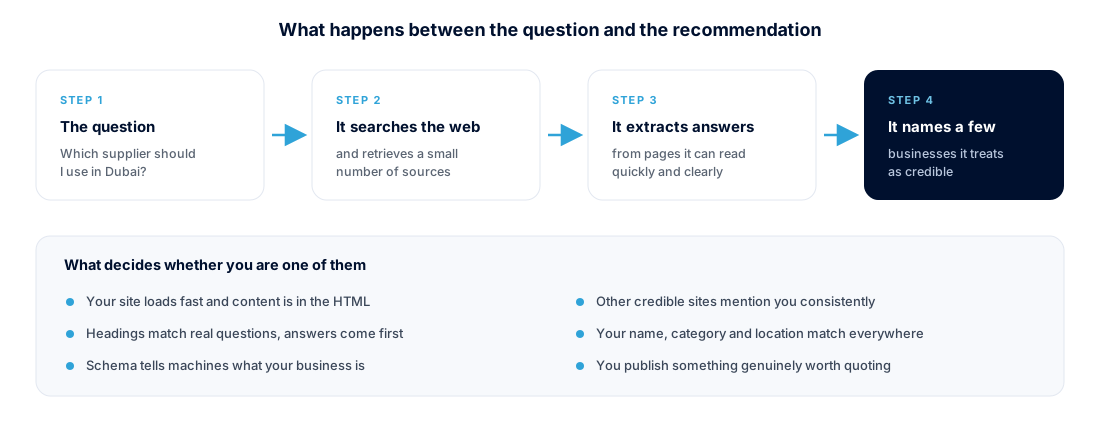
It helps to understand what is happening underneath. When you ask ChatGPT for a recommendation, it is not consulting a ranking list. It is either drawing on patterns in its training data, or, more commonly now, searching the live web and summarising what it finds from a small number of sources it treats as reliable.
That produces three practical routes to being mentioned. Your business appears in the sources the model retrieves when it searches. Your business is described consistently enough across the web that the model has a clear understanding of what you do. And your content is structured in a way that makes it easy to extract a direct answer from.
None of these are tricks. They are the same fundamentals that make a site rank well, applied with attention to how machines read rather than how people skim.
Step one: check where you currently stand
Before changing anything, establish a baseline. Ask ChatGPT, Gemini and Perplexity the questions your customers would actually ask. Not your brand name, which proves little, but the commercial questions: which company should I use for this service in my city, what are the best providers of this product, who do you recommend for this problem.
Record which businesses get named, whether you appear at all, and how the assistant describes you if it does. Inaccurate descriptions are common and worth fixing on their own. Repeat this monthly, because answers shift.
Step two: make your site readable to machines
AI systems retrieve and parse pages under time constraints. Sites that are slow, render content through heavy JavaScript, or bury answers in marketing prose are harder to use and get skipped in favour of clearer sources.
The practical work here is the same as good technical SEO: fast server responses, content present in the HTML rather than assembled after load, clean heading structure, and valid schema markup describing what your business is and what it offers. Organization and Service schema in particular help these systems associate your brand with the right category.
Step three: answer questions directly
This is where most business websites fail. Marketing copy is written to persuade, so it circles the point. AI systems extract answers, so they favour content that states the answer plainly and then explains it.
In practice: use headings that match real questions, give the direct answer in the first sentence or two beneath each heading, then add the detail. If someone asks how much something costs, publish a range and explain what drives it rather than inviting them to enquire. Content that refuses to answer is content that cannot be cited.
Step four: build third party corroboration
This is the part that cannot be shortcut and the reason most businesses will not do it. AI systems weight what others say about you far more heavily than what you say about yourself.
That means mentions in publications with editorial standards, which is what digital PR produces, alongside genuine reviews, accurate directory listings, and consistent business information everywhere your name appears. If three sources describe your business differently, the model has no confident basis for recommending you.
Consistency matters more than people expect. Your business name, category and location should read identically across your site, your Google Business Profile, your listings and your social profiles.
Step five: be the source that gets quoted
The most durable route to being cited is publishing something worth citing. Original data about your market, a genuinely useful explanation of a problem in your field, or a clear comparison nobody else has written. Models retrieve and summarise substantive sources, and substance is comparatively rare.
This overlaps almost entirely with good content marketing. The difference is emphasis: write to be quoted rather than merely to rank.
What does not work
Keyword stuffing for AI, hidden text aimed at crawlers, and mass generated content all fail for the same reason. These systems are summarising sources they consider credible, and low quality content does not become credible by being repetitive. Directory spam and paid mention networks are similarly ineffective, because the sources being cited are the ones with editorial reputation.
Why this matters more in the UAE right now
The competitive picture here is unusual. Very few businesses in this market are working on AI visibility deliberately, and many established competitors with strong domains have no strategy for it whatsoever. That gap is temporary. The businesses accumulating citations and consistent entity signals now will hold those positions while others are still deciding whether it matters.
If you want to know how AI platforms currently describe your business, and what would need to change for them to recommend it, our generative engine optimization service covers exactly that, or you can send us your website and we will check.